
Why Asking the Dog Matters: Understanding Canine Consent and Respectful Greetings
Most people know they should ask the owner before petting a dog.
Unfortunately, that’s often where the conversation ends.
An owner may say, “Sure, go ahead, he’s friendly!” and within seconds a stranger reaches over the dog’s head, pats them, hugs them, or invades their personal space. While the person’s intentions may be kind, one important voice has been left out of the conversation:
The dog’s.
At Good Behavior Dog Training, we believe dogs deserve the opportunity to communicate whether they want to interact or not. Just because a dog is friendly does not mean that dog wants to say hello to every person they meet.
Just like people, dogs have preferences, moods, boundaries, and comfort levels that can change from moment to moment.
Dogs Communicate Constantly
One of the biggest misconceptions people have is believing that a dog must growl, bark, or snap to communicate discomfort.
In reality, dogs begin communicating long before they ever feel the need to escalate their response.
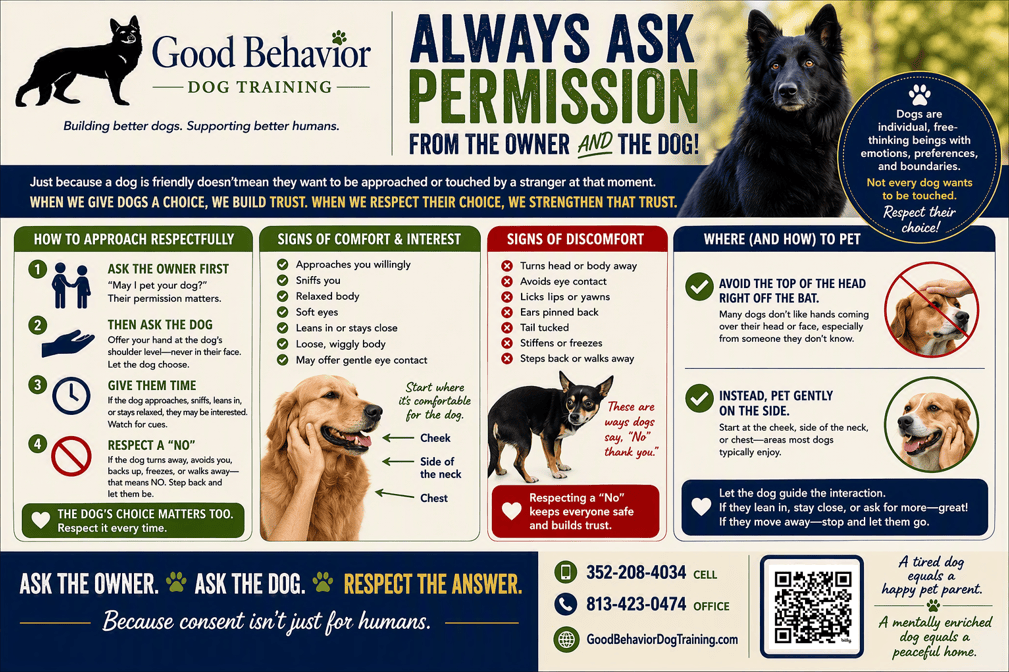
A dog may politely say “I’m uncomfortable” by:
- Turning their head away
- Looking elsewhere
- Moving behind their owner
- Avoiding eye contact
- Licking their lips
- Yawning
- Freezing briefly
- Walking away
These subtle signals are easy to miss, especially when someone is focused on petting the dog rather than listening to what the dog is saying.
When those signals are ignored repeatedly, the dog may feel forced to use stronger communication methods.
What Does a Dog’s “Yes” Look Like?
When I ask a dog for permission, I’m not using words. I’m paying attention to body language.
A dog that is interested in interaction may:
✅ Approach voluntarily
✅ Sniff calmly
✅ Display a loose, relaxed body
✅ Maintain soft eyes
✅ Lean in for attention
✅ Stay close and seek engagement
The key word here is voluntarily.
The dog chooses to approach.
The dog chooses to remain.
The dog chooses whether the interaction continues.
This gives the dog a sense of control and helps create a positive experience.
What Does a Dog’s “No” Look Like?
Many dogs politely decline interaction.
The problem is that humans often ignore their answer.
Signs a dog is not interested include:
❌ Turning away
❌ Moving away
❌ Stiffening
❌ Hiding behind the owner
❌ Avoiding eye contact
❌ Tail tucked tightly
❌ Ears pinned back
❌ Lip licking or yawning
When a dog gives these signals, the respectful response is simple:
Give them space.
There is nothing wrong with a dog deciding they do not want to interact with a stranger. In fact, that decision should be respected and appreciated.
Stop Reaching Over the Dog’s Head
One of the most common mistakes people make is reaching directly over a dog’s head.
Imagine meeting someone for the first time and having that person immediately reach toward your face.
Many dogs find this intimidating.
Instead, allow the dog to approach and begin interaction on the side of the body.
Good starting locations often include:
- Cheek area
- Side of the neck
- Chest
These areas typically feel less threatening and allow the dog to remain comfortable.
Always let the dog determine whether the interaction continues.
Teaching Children to Respect Dogs
This lesson is especially important for children.
Children who learn to ask both the owner and the dog develop empathy, awareness, and respect for animals.
Teaching children to pause, observe body language, and respect a dog’s decision can help prevent misunderstandings and create safer interactions for everyone involved.
A dog that feels heard is far less likely to feel pressured.
Consent Builds Trust
When we allow dogs to make choices, we build trust.
When we respect those choices, we strengthen trust.
The goal is not to convince every dog to interact with us. The goal is to make dogs feel safe enough to communicate honestly.
Sometimes the answer will be “yes.”
Sometimes the answer will be “no.”
Both answers deserve respect.
The next time you meet a dog, remember:
🐾 Ask the Owner.
🐾 Ask the Dog.
🐾 Respect the Answer.
Because consent isn’t just for humans.
Good Behavior Dog Training
🌐 GoodBehaviorDogTraining.com
📱 Cell: 352-208-4034
☎️ Office: 813-423-0474
“A tired dog equals a happy pet parent. A mentally enriched dog equals a peaceful home.” 🐾
 Good Behavior Dog Training
Leave a comment