
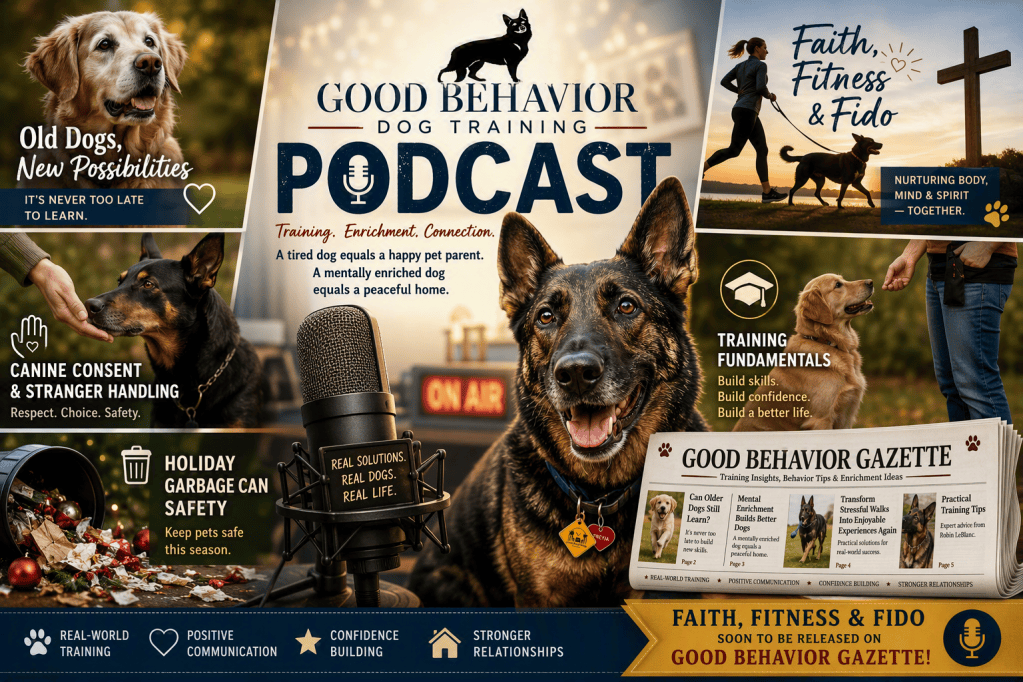
Pip: Good Behavior Dog Training has a lot to say this week — about old dogs, stranger's hands, holiday garbage cans, and the spiritual life of your Labrador.
Mara: That covers the territory well, actually. Good Behavior Dog Training published across training fundamentals, canine consent, seasonal pet safety, and a new faith-based program called Faith, Fitness, and Fido. Let's start with the training questions — specifically, whether age is ever really the obstacle owners think it is.
Old Dogs, New Possibilities
Pip: The premise here is a challenge to one of the most durable excuses in dog ownership — the idea that once a dog reaches a certain age, the window for change has quietly closed.
Mara: The post "Can Older Dogs Still Learn?" addresses that directly. The setup is the phrase owners repeat most often, and then it lands this: "A tired dog equals a happy pet parent, but a mentally enriched dog equals a peaceful home."
Pip: So the argument isn't just that old dogs can learn — it's that mental engagement is its own category of need, separate from a long walk around the block.
Mara: Right. The post is specific about what changes with age: stronger established habits, a need for more repetitions, sessions tailored to physical limitations, and a slower pace. But none of those are reasons to stop. They're reasons to adjust.
Pip: Which is a meaningful distinction. "Your dog is different now" is not the same sentence as "your dog is done."
Mara: The post lists concrete problems that older dogs regularly improve — leash pulling, reactivity, jumping, confidence issues. These aren't edge cases. They're the most common reasons owners call a trainer in the first place.
Pip: And the framing of success is worth noting. It's not a perfect dog. It's a dog that can walk calmly through the neighborhood, or stay relaxed around visitors, or handle a vet visit without a scene.
Mara: "Mastering Dog Training: Tips for Better Behavior" reinforces the same foundation — consistency, short focused sessions, positive reinforcement, and working up gradually through real-world environments. The practical mechanics are the same regardless of the dog's age.
Pip: There's also a post built around Amber, a dog whose owner worked with trainer Robin LeBlanc — first at home, then out in public places like Home Depot. That one makes the point plainly: "Training is not an event. Training is a process."
Mara: And the socialization piece fits here too. The post on socializing your dog connects to the same through-line — exposure, consistency, and building a dog that can function reliably when the world gets noisy.
Pip: Which raises a question about what the world asks of a dog — and what the dog gets to say about it.
Reading the Dog's Answer
Pip: This segment is about a gap most people don't know exists — between asking the owner for permission and actually checking with the dog.
Mara: "Always Ask Permission from the Owner AND the Dog" makes the case plainly: "Just because a dog is friendly does not mean that dog wants to say hello to every person they meet."
Pip: So owner permission is necessary but not sufficient. The dog has a vote, and it's being cast whether or not anyone is watching for it.
Mara: The post walks through what a dog's yes and no actually look like — voluntary approach, relaxed body, soft eyes on the yes side; turning away, stiffening, lip licking, hiding behind the owner on the no side. It also flags reaching over the dog's head as one of the most common mistakes, and recommends starting contact at the cheek, neck, or chest instead.
Pip: The children's angle is practical — kids who learn to read body language before reaching develop a habit that prevents a lot of preventable incidents.
Mara: The post frames it simply: a dog that feels heard is far less likely to feel pressured. Consent builds trust, and respecting the answer strengthens it.
Holiday Hazards Worth Knowing
Pip: The holidays bring new smells, new foods, and new opportunities for a curious dog to end up at an emergency vet — which is the actual subject of this segment.
Mara: "Holiday Hazards: Keeping Your Pets Safe During the Festive Season" covers the list in detail. On food alone: cooked poultry bones, rich gravies, onions, garlic, grapes, raisins, xylitol, chocolate, uncooked yeast dough. The post notes that "the holiday season can also be one of the busiest times of year for veterinary emergency clinics."
Pip: Xylitol is the one that still surprises people — it turns up in sugar-free gum, certain peanut butters, baked goods.
Mara: Decorations carry their own risks: tinsel, ribbon, low-hanging ornaments, tree water that accumulates fertilizers and bacteria over time. The post recommends a tree skirt or barrier to reduce access. The ASPCA Poison Control number it provides is 888-426-4435, if listeners need it.
Pip: The prevention note at the end loops back to training — a mentally enriched, well-exercised dog is less likely to invent its own holiday entertainment.
Faith, Fitness, and Fido
Pip: This one is genuinely its own category — a program that combines trail walks, scripture, fitness stations, and dog training into a single outdoor experience.
Mara: "Coming Soon: Faith, Fitness and Fido" announces the launch and frames it around four pillars: faith, fitness, the dog, and what it calls victory — the idea that participants are walking from a position of grace rather than striving toward one. The post quotes 1 Corinthians 15:57: "But thanks be unto God, which hath given us victory through our Lord Jesus Christ."
Pip: So the trail stations aren't just exercise checkpoints — each one pairs a fitness challenge with a dog training exercise and a scripture passage.
Mara: "Welcome to Faith, Fitness and Fido" adds the foundational mission statement: "Faith, Fitness and Fido exists to encourage individuals and families to glorify God through faithful stewardship of their spiritual lives, physical health, and the animals entrusted to their care." Training, in this framing, becomes an act of stewardship.
Pip: Old dogs learning, dogs getting a vote in their own greetings, holiday garbage cans as genuine hazards — there's a consistent thread here about paying closer attention to what dogs are actually experiencing.
Mara: And Faith, Fitness, and Fido suggests that attention extends outward — to community, to health, to what you're doing with the time you have with your dog. More to come on all of it.
 Good Behavior Dog Training
Leave a comment